Sunday, December 5, 2010

Uncle Tupelo in the hothouse basement


Sparked by the inaugural Uncle Tupelo tribute show in St. Louis last night, I feel like posting some chapters from my musical memoir that deal with those guys. This is Chapter 15. Though it references previous chapters by dropping band names previously elaborated (Judge Nothing, Chicken Truck), it stands alone as a description of early Uncle Tupelo and the musical culture in Cicero's Basement Bar during the late 1980s that helped to nurture them
.

In the Hothouse Basement
By Chris King

Very few people remember the first time they saw Uncle Tupelo at Cicero’s. That is because you didn’t actually see Uncle Tupelo at Cicero’s. You saw the backs of people who saw the backs of people who saw the backs of people who saw the backs of people who saw Uncle Tupelo.

Through a sea of flannel shirts (worn for comfort, not for fashion) and baseball caps (worn in lieu of hairdo, perhaps in lieu of shampooing), you saw flashes of fragments of Uncle Tupelo. Jay Farrar, the least expressive but most central of the three, already judged a mystery owing to his severe shyness, might be glimpsed peeking though a bang as he delivered a lyric. Jeff Tweedy, the chatty bassist and apologetic hitter and misser of harmonies, enacted the band’s constant pace changes with jumps and wobbles that sent him bouncing off the walls. Most everyone could see at least one frame of those near-falls. The drummer, Mike Heidorn, was most visible at rest. When the sea of people parted between songs, sipping or fetching drinks, he sat revealed behind his drum kit, opening his neck for a long pour of beer.

When Heidorn was replenished, and Jay had adjusted the settings on his amp through his bangs, and Tweedy had promised his next harmony would be better, they would hit again. Instantly, everyone would remember why they were standing in a crowded basement with the bill of somebody’s baseball cap digging into their neck. These guys had it. Jay’s voice had a veteran’s poise and a whiskey-red tone all its own, and Tweedy’s harmonies added tenor highlights to its prematurely aged depths. From time to time, the night would be pierced by a rightness you simply never hoped to hear from a pair of local microphones. Tweedy’s voice had a babyish register that served, to my ears, as a useful comment on the lyrics. When you could hear what Jay was singing, it was about a weary world and a dismal day in it. It brought distance into the eyes of all the drunks at the close of a show when Jay sang about drinking yourself to sleep, but I didn’t buy it. Those lyrics didn’t seem deeply lived to me. Tweedy’s harmony vocal, however, made them livable. I heard a kid’s joy in singing undercutting Jay’s perpetual dirge.

Jay's dire ballad “Life Worth Living” was the swaying, singalong culmination to an Uncle Tupelo show. There was a long climb up to that quiet place. It was mostly nasty, slash-and-burn post-punk rock. A Husker Du rhythm hand whipped through simple folk chords with sudden snarls of riffs and blistering miniature guitar solos. Three guys played as one. This band had been hammered tight in its Belleville woodshed. Whatever was driving them apart and troubling their friends in Chicken Truck was inaudible when they plugged in and played. Fingertips stilled cymbals just as hands muted strings, creating instant silences in the middle of songs. Then everything crashed back in with a single, urgent, vicious strike. There was twang in that whiskey voice, and anger in the band. It wasn’t country punk, quite, it was the next stop on the line. It was so damn good that many have been tempted to name it. Insurgent country, alternative country, alt. country, twang. Country post-punk was how it always sounded to me in the basement where it grew from a boy to a man.

Tupelo was also a well-stocked human jukebox. Even though they set the standard for the “original music” scene in St. Louis, Uncle Tupelo was a great cover band, too. These young, fresh-faced guys from the wrong side of the river had done their homework. They could take you on a breakneck, slam-and-jam tour of the history of American music, from the Carter Family, who brought the old as the hills music out of the hills and onto the radio, to Credence Clearwater Revival and Neil Young, who juiced up folk styles in the 60s and 70s, all the way up to my Meat Puppets, whose derangement of country ballads was obviously one of the primary source forms in the Belleville woodshed.

It is fair to say that everyone heard Uncle Tupelo at those early Cicero’s shows. They certainly played loud enough for that. The sonic experience in that basement left something to be desired, though. There was no escaping the fact that this was loudly amplified music in a narrow concrete basement, administered by a sound system (two generations beyond the initial Judge Nothing rig) that was hardly worthy of the bands it first delivered to the world.

The tiny, concrete confines of Cicero’s damaged its sound and cramped its crowd on a big night, but its size was essential to its role in growing a local scene. Twenty five people on a Tuesday night felt good in that basement bar. The biggest staggering-room-only Tupelo draw would have looked dinky in most of the clubs on Laclede’s Landing, the renovated St. Louis riverfront. The Landing bands played radio hits as wallpaper music for vast numbers of people not looking to discover anything new about music (or themselves). The Landing clubs were impersonal places of employment, where working musicians made a buck making it easier for people to get drunk enough to get laid. Cicero’s was hothouse soil. Bands shot up fast, because it seemed possible there, and only there, to shoot right through the roof and keep growing, perhaps snagging a few of your friends on your branches and taking them for a ride. The urgency of Uncle Tupelo, and their charisma, was inseparable from Cicero's soil.

*

From And Let Him Ply His Music: Adventures in Post-Punk and Amateur Folklore (unpublished)

Picture of Uncle Tupelo in Cicero's by Toby Weiss.


Sunday, November 28, 2010

Father Micheas, Fort Bragg priest of peace


I was surprised to be approaching intake at an Emergency Room as we went into Mass this morning. It was a hospital on post at Fort Bragg, and Mass was held in a small room on the third floor. As we entered the chapel, the paraphenalia of the rite was being assembled on what passed for a sanctuary. Given the military setting, I was struck by the similarity to hurriedly making camp after a day's march. It seemed like a bivouac Mass.

The priest, an elderly man with piercing blue eyes, began by calling attention to his purple robes. He said purple was proper to the celebration of Advent, which started today. Holding up what I would have called his sash, he said his stole was from Vietnam. He pointed to the wooden stand upholding the Bible on the altar and said it was from India.

He began a prayer, explaining he was using the Canadian version; the Canadian bishops, he said, did a better job with many prayers than the American bishops did. He showed us the book of Canadian bishop prayers he would read from and admitted the book was borrowed. His original copy, he said, had been lost in shipment from the north of Turkey when he left there.

Sitting in a pew, an American with a wife from Togo, surrounded by her family from Ghana, I was deeply pleased by his casual internationalism, especially on a military post. The U.S. Army, after all, is not commonly associated with the more enlightended, compassionate, humanitarian aspects of internationalism.

The surprises were only beginning. The first reading was from the prophet Isaiah. It included the following: "They shall beat their swords into plowshares and their spears into pruning hooks; one nation shall not raise the sword against another, nor shall they train for war again."

"Nor shall they train for war again"? Fort Bragg existed specifically to train for war!

The second reading, from Paul's Letter to the Romans, was more of the same: "Let us then throw off the works of darkness and put on the armor of light". The "works of darkness" that agitated Paul were orgies, rather than acts of aggression, but I know Fort Bragg does not hand out "armor of light" as standard issue to its infantrymen.

I knew, because the priest has taken the trouble to tell us, that these readings were ordained by the Church as part of its scheduled cycle of readings. I wondered what, if anything, he would make of this pacifist stuff in his homily, addressing an Army post parish in a time of war.

He went right at it. He said the prophet Micheas also spoke of turning swords into ploughshares. Then he pointed out a statue on the altar. I had noticed it earlier; it looked like a burly man doing something vaguely athletic. The priest pointed out that it was Micheas beating swords into ploughshares. He wished he could pass around the statue, he said, but it was too heavy. I found it touching that he wanted these military parishioners to hold in their hands this aggressive symbol of peace.

He dwelled on the subject further. He produced a picture. He said it was an image of Micheas from the National Shrine. This image was more static, less active, but there he stood, holding a hammer in his hand, the hammer that turned swords into ploughshares.

After Mass, the priest invited us across the hall for juice, cookies, and fellowship. We joined him and a smattering of the parishioners. I waited my chance to approach the man. Up close, his pale blue eyes were all the more piercing. His nose was veiny, and he had a scar on his chin that looked like it had been a nasty wound, once.

I mentioned the scripture about not training for war anymore. "That would put Fort Bragg out of business, wouldn't it?" I said.

He nodded, and said, "That would be a good thing."

I asked for his contact information - I was only visiting - and he produced for me his card. His name: Father Micheas.

*

Image of the prophet Micheas from the Lady Chapel, Gloucester Cathedral, borrowed from Vidmus.

Sunday, November 21, 2010

Letter from Les Murray: on being 'willfully grungy'


I am fortunate to enjoy a long-distance friendship with one of the greatest living poets in our language, Les Murray. Given that Les lives in rural New South Wales, Australia, this is a very-long-distance friendship, both trans-Atlantic and trans-Pacific, since when your friend lives on precisely the other side of the world it doesn't matter which way you go to get there.

In fact, I have never been, though I've been invited and do mean to go see him one day on Cecil's Lane, a road named for his father. As it is, I send him letters and things we are working on at Poetry Scores, and he sends back letters, poems, or very large postcards filled with his scrawl.

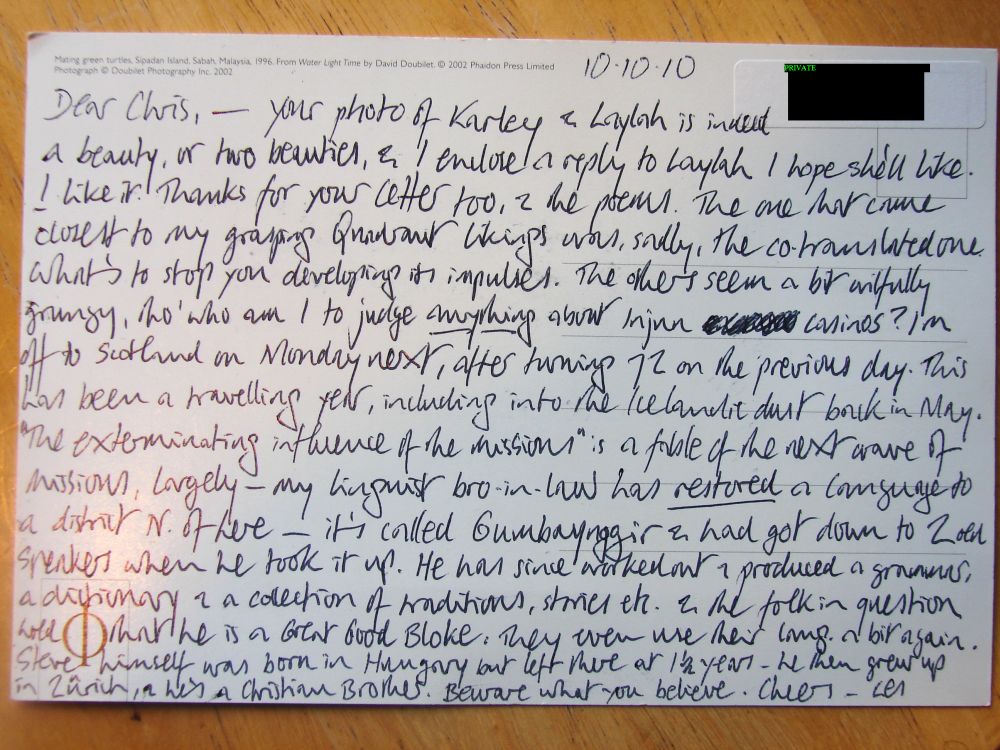
One just received -- dated, nicely, "10-10-10" -- taught me some things. It responds to a package from me that, typically, included a photograph of my wife and child. When Les first visited us in New York, my wife Karley was pregnant with our daughter Leyla; and he is the thoughtful sort who always has remembered that, so I keep him updated on them.
Your photo of Karley & Laylah [his spelling] is indeed a beauty, or two beauties, & I enclose a reply to Laylah. I hope she'll like. I like it.
His reply comes in the form of a photo of a blue bird sitting in Les' wide palm


No legs are visible. Though they could be tucked under its tufts of feathers, I imagine the bird to be legless or in some other way disabled, a natural reclamation project for the poet, an impression encouraged by a note in Les' inscription on the back.


Hi Leyla [getting the spelling right]! I'm happy to see you & your mother looking so well ------- and the blue bird is happy to be looking at all! Love from Les
I know, the tiniest acknowledgement from Justin Bieber would mean much more to Leyla herself, but I am  very proud to have encouraged correspondence between my 7-year-old and a poet whose work will out live us all.

Les also responds to some poems and co-translations of the Turkish poet Orhan Veli I had done with my friend Defne Halman. Les edits the literary section of a conservative Australian magazine named Quadrant and surprised me years ago by printing some work I had sent him; so now, though the friendship is primary to me, there is also a slight strain of literary hopeful in me whenever I send him a package in Australia.
Thanks for your letter too, & the poems. The one that came closest to my grasping Quadrant linkups was, sadly, the co-translated one. What's to stop you developing its impules. The others seem a but wilfully grungy, tho' who am I to judge anything about Injun casinos?
That means I must have sent him this poem:
THE WOUNDED KNEE KIDS BOXING CLUB
Kids are making dream
catchers for tourist pennies
The Wounded Knee Kids
Boxing Club needs money
for gloves    for gas to bruise
and travel
They have been pouring
water on their heads all day
Casino roof
the only shade    The old
massacre creek dry
like any other rut
Oh    the elite set
get seventy new houses    says the Wounded
Knee Kids Boxing Club coach    Casino
money never goes to kids
I used to have a phone    Now
I have forty-five kids    Lucky
I still got a TV
The kids
are all
on fire
This is an old poem, just this side of journalism, a bare factual report of a visit to Wounded Knee, the Sioux massacre site. The next brief bit of Les' letter is the only part of this one that is properly personal.
I'm off to Scotland on Monday next, after turning 72 on the previous day. This has been a traveling year, including into the Icelandic dust back in May.
This relates to the Eyjafjallajökull volcano eruption that made worldwide news in 2010. Les moves from this reflection to another poem I had sent, and another unpronounceable name.
"The exterminating influence of the missions" is a fable of the next wave of missions, largely -- my linguist bro-in-law has restored a language to a district N. of here -- it's called Gumbaynggir & had got down to 2 old speakers when he took it up. He has since worked out & produced a grammar, a dictionary & a collection of traditions, stories, etc. & the folk in question hold that he is a Great Good Bloke. They even use their lang. a bit again. Steve himself was born in Hungary but left there at 1 1/2 years -- he then grew up in Zurich, and he's a Christian Brother. Beware what you believe. Cheers -- Les
Wow! That's a lot to unpack at the end of a note scrawled on the back of a postcard that depicts mating sea turtles.
First, let me share my poem he is responding to.

VOCABULARY LESSON

FOR THE LAST PERSON
OF THE TRIBE TO SPEAK
THE LANGUAGE
OF OUR PEOPLE


For arrow poison, gall was boiled

down. She soaked his nuts in cum
Sundays, lengthy Elizabethan prose
Sundays, in Kansas City, Kansas.
The hair was at times plastered with clay
for 24 hours, to impart gloss
and keep it from split
ting. The exterminating
influence of the missions
was discouraging, sure,
but courage, for survivors,
was really just a curse.
A is for Absence,
B is for Bayonet in the Back of
C, or Crazy Horse,
D is for Don’t You Dare Speak Your Mother Tongue,
E is for Entrails Emptying Out of Our Soul.

Now that Les Murray mentions it, this is "willfully grungy," what with the nuts soaked in cum and splitting the word "splitting" between two lines. I suppose he and I may disagree about the value of being "wilfully grungy" -- it serves as an apt summary of punk rock, an aesthetic I respect -- but it's good to know where you are coming from, and Les has shown me once again.

If I may quibble with the great poet, however, this poem is not about the next wave of missionaries but rather the first missionary wave in American Indian country, where the languages were willfully annihlated, along with as many of the people as the bad guys could throw a measle blanket on. I'll enjoy discussing this in Bunyah one day with Les Murray and his bro-in-law Steve the linguist Christian Brother.


Saturday, October 16, 2010

Three Angela Khan poems for Andrea Van Cleef to sing


I have a new friend, Angela Khan, who uses chat software. I am getting used to it. We banter about projects, poetry, and philosophy on these little pop-up boxes in the morning.

The other morning, she tells me also is chatting with Andrea Van Cleef.


This is my Northern Italian rocker buddy. I know social media makes it infinitely easier for anybody to be a catalyst, but as an O.C. (Original Catalyst), I still pride myself in connecting people up.

Khan is getting mobbed up in our project Poetry Scores, so I told her Andrea is the one musician who has scored me. I populated our chat box with a link to a demo of his song to my poem "I used to be precocious".

Then, I really got to thinking. Khan had just sent me some of her own poems. My first thought was that they would be fun to sing. So I told her I would post her poems and send the link to Andrea and see if he could come up with some songs.

The Quiet Room
By Angela Khan


Murderous imaginings are suppressed in the light blue room
Confined shadows compress against the break room’s skin
slaloming through the silence, a slavish floor to broom

echoes race but time always wins
down the hallway donning a boyish grin
and stooping yet strong, the figure’s work never ends
sweeping accusations - life's blind custodian
begins to whistle woes unforgivable

in the coded key of Zen

Kind of reads like a Natalie Merchant lyric to me.

Bastille day is today
By Angela Khan

Bastille day is today
ever heard of this celebration?
You think you’re the King; I'm French; pay attention---

Behead thee King and drama Queen
I'm casting thy booty to the sea
your riches nil value and useless to me
Let us chisel this date into your dull memory
Rest your neck upon it's cold nape

Run through your lines just one more time before never
it is too late
to tip me
Learn from the stillness of the stone
and its silence
Even your darkest knights are lame
like your face we've saved from the
wages of slaves

Tails down You lose!
Heads off!
just proves
today is the day Bastille!

I'm melting the molds of victory waxes
paid for with your Icarus' taxes
Bastille!

Hone the blade
then bury the axes
Mark my face with Pheonix' ashes!

I'm writing you off with the ink from your spill
take a hard look what's come from this quill
thank you
thank you
thank you

Today we celebrate my Bastille!
Come to think of it, that also has a touch of early Natalie.

red on red
By Angela Khan

Moving away from or coming towards depending on the wave length in colors and the speed at which I hover contemplating red I pull the covers over my head and the blackbirds aren't birds they were rats in a dream I once had when I was running over past events in my memory bare feet protected by angels didn't cut over bottles broken in an alley careless of the crime motion blurred visions of one time when I hadn't a dime or second to spend running through alleyways in my head it didn't matter much because my feet were tough and I owned no watch on the wrist to say late to the party to tell a story so great about love and loss of no blood and the police breaking rules to give me a lift and wishing me well in this here district why didn't I tell them? that My favorite Italian shoes were in that bag too. And what of the artwork that took a semester to do? Nevermind my faith in humankind and nevermind all of those things once called mine. Nevermind. Nevermind. Nevermind. Back to

contemplating red on red

And that one even has "Italian shoes"! Come on, Van Cleef, you can do something with that.

Monday, October 4, 2010

Tim McAvin, amateur soldier actor, is holding hostage my shoes


As the King/McAvin shoe hostage crisis enters its second week, I have taken to wearing my dress shoes to work. This situation is getting serious.

It all started on location in Cuba, Missouri, one week ago yesterday. It was our first day of shooting the new Poetry Scores movie, Go South for Animal Index. After a long day down at the creek, shooting our Coyote character (Kyla Webb) trading his moonshine to PFC Sack (Thom Fletcher) for hamburgers and to Badger (Roland Franks) for fresh fish, we moved up to the McPheeters' house.

I had picked out an upstairs porch to shoot the country dance scene. Our movie is based on a poem of the same name by Stefene Russell that is about the atomic bomb. My storyline centers on Lost Almost, as the soldiers called Los Alamos, where the first atomic bomb was invented and tested. The scientists lived a fairly active, if insular, social life when they weren't splitting the atom and weaponizing the resulting energy, and I wanted to reflect this fact with a mad scientist country dance.

Lost Almost was a secret military installation, and since we make silent movies, the best way to make this clear to the viewer is to have armed soldiers present at almost all times. So I asked for our soldier actors (Fletcher, Thomas Crone, Tim McAvin, John Parker) to make this shoot so they could surround the scientists and their wives while they danced.

We were just about to start shooting when I reviewed our soldiers' costumes. Everybody was looking pretty good. Then I looked down at McAvin's shoes. They were brown sneakers. When I asked the soldier actors to costume themselves, I specified black boots for their footwear. Brown sneakers absolutely would not do

Photo by V "Elly" Smith

My fussing about this costume blunder called attention to Tim's shoes. Since I was standing right in front of him, this also called attention to my shoes. Barbara Manzara, who is playing a scientist wife but also had been helpful all day with costumes, pointed out that my shoes - my beloved, lovely shoes - were black. At a glance, which is all the viewer would ever give the shoes of any of our soldiers, they would pass for boots. So Tim and I switched shoes.

Photo by V "Elly" Smith
It turns out we have almost exactly the same sized foot. The show went on, and I am quite certain no one who ever sees our movie will guess that one of the soldiers is wearing beloved, lovely black shoes that are not boots.

Directing a movie all day is a heady, exhausting experience. It takes you out of yourself. I stopped think about my feet or my shoes. By the time I started thinking about my feet or my shoes again, the shoot was over and Tim McAvin was gone from the location, he was absent from Cuba, he was on his way back to St. Louis wearing my beloved, lovely black shoes. I was stuck with the brown sneakers.

I am certain that Tim was able to walk off with, and in, my shoes because they fit so well. Tim and I carry our weight in a remarkably similar fashion. I have a long history of neck and back injuries and am unusually sensitive to how I bear my weight. I wouldn't last an hour in the shoes of a man who carried his weight in a way that felt wrong to me. I am sure my shoes felt right on Tim, because Tim's shoes felt pretty right on me.

They felt pretty right on me for a day or two, that is. Then, they started to feel wrong. The small differences in how we bear our weight and have imprinted our shoes began to become obvious to me. Tim's shoes began to bother me. My back began to ache. I don't really have any other comfortable, casual shoes. I was stuck with Tim's brown sneakers.

So I started to take my shoes - that is, Tim's shoes - off at work. The people who work with me began to object to this, and who could blame them. And so I, a week now into the McAvin/King shoe hostage crisis, I have started to wear my dress shoes to work.

I like my dress shoes. They are perfectly comfortable shoes. But they are not my beloved, lovely black shoes. Those shoes are in the custody of - in effect, being held hostage by - one Tim McAvin. And I want them back!

I have tried to get them back one time. One evening last week, This is where it starts to get suspicious. Oh, sure, Tim said. You can come and get your shoes. No problem. But you'll have to come and get them, he said. He didn't have a car that night. I took down his address. I drove toward his home in South County. As I drew near, to nail down directions to his door, I called Tim.

And, suddenly, there was no Tim on the phone. Suddenly, his phone was doing that thing when the person who has the cell phone plan tells the cell phone company his phone isn't going to be a working phone for awhile. Tim dodged me. Tim is dodging me. Tim is holding my shoes hostage! Tim, bring me back my beloved, lovely shoes!

Saturday, September 18, 2010

Meriwether Lewis's woodpecker pecks again


I'll admit I'm not a hashtagger, and I'm old enough to remember vividly a social life before the internet, which leaves me a little cranky about meme-chasing as a means of communicating.

Come to think of it, I remember the meme-chasing equivalent before there was social media meme-chasing. It was the thing where people spoke solely in quotes from movie dialogue. That really sucked.

But interconnections can be fun when they are genuine. They can lead to fresh discoveries and new, instant intimacies.

So I followed a Twitter link from a guy I don't otherwise know named Scott Edward Anderson. Scott was riffing on a post by another guy I don't know named Jim Behrle, having sardonic fun with the genre of The Dead Bird Poem. Jim's post takes this trail back to a Facebook message sent to him, turning this dead bird poem thing into a bona fide, multi-platform meme without the breathy artifical perspiration of a #hashtag.

The post by Jim Behrle, which references one of his own dead poems about a dead bird, elicited from Scott Edward Anderson a dead poem of his own about a Dead Red Wing.

I dig talking to people through Twitter, so I told Scott his post and poem reminded me that I had written a poem about a dead bird brought back from the West by Meriwether Lewis, that subsequently was named for the captain explorer, Lewis's Woodpecker.

Scott said he hoped I'd share the poem. That was encouragement enough for me. Some document searching on the trusty old laptop, and this here dead poem has new wings:

*

LEWIS'S WOODPECKER
By Chris King


I was happy to see you
dapper man in sooty black
jacket, reddish vest, with toe
nail issues, though, and a bit
grizzled, muzzy, matted about
the neck, tail feathers scruffy.
Woodpecker with a necklace, a Kamiah,
Idaho, exile, a holotype, neighbor
of the innards of asteroids, giraffe
scapula mixer of poisons.
Property of Harvard, now, from Charles
Wilson Peale and your namesake captain,
Meriwether, with Golden Pheasants Peale
asked of President Washington, tactless,
while they yet flapped. “I cannot say
that I shall be happy to have it in
my power to comply with your request,”
General George wrote Peale, “but expect it
will not be long before they will compose
a part of your museum, as they appear
to be drooping.” Meriwether Lewis
chased you like a northern flicker
through the Rocky Mountains, caught you
in the Bitterroots, spotted the glossy
tint of green in you in certain light,
thumbed the barb of your pink tongue,
author of song on the Upper Missouri,
marveled at how oddly artificially
painted in blood red and white your
breast and belly seem and the yellowed
browns of muscly iris in your purple eyes
only when you were in his canoe, composed.

*

As I recall, this was written in the presence of the actual specimen that had been brought back personally by Meriwether Lewis. I was a magazine travel editor for years and went to museums everywhere, so I can't remember where I saw it.

Oh yeah, I forgot. The internet knows everything. I asked Google and it sent me to the Library of Congress, which told me the specimen is birdhoused at the Harvard University Museum of Comparative Zoology, which checks out; I must have done a dozen Boston stories.

That is the picture of the bird, above, from the LoC.


Saturday, June 26, 2010

Tramp and burlesque live stage show with silent film


Lola van Ella and Sammich the Tramp present
“The Golden Age ... Live on Stage”

Lola van Ella and Sammich the Tramp will present “The Golden Age ... Live on Stage: A Silent Night in Black & White” at 9 p.m. Saturday, July 17 at Off Broadway, 3509 Lemp Ave.

This unique – perhaps unprecedented – event will combine St. Louis burlesque at its sexiest with the art of the silent tramp (as perfected by Chaplin and Keaton, and revived by Sammich). It will combine live stage shows – burlesque, tramp – with silent film screened to live music by St. Louis’ own (and only) The Rats and People Motion Picture Orchestra and Kevin O'Connor.

This event springs from the stunning finale to the inaugural (2010) Show-Me Burlesque Festival. Lola van Ella and Sammich the Tramp stunned and then wowed audiences with a Lady & the Tramp stage show that opened with all the delicacy and mixed moods of Chaplin … but ended with Lola on a swing!

[See Hannah Radcliff’s artful video of their performance of Lady & The Tramp at the 2010 Show-Me Burlesque Festival: http://vimeo.com/12079789.] **

“The Golden Age ... Live on Stage” will feature an elaborated version of this piece, scored live by The Rats and People Motion Picture Orchestra. It also will feature the premiere of Kevin O'Connor’s original score to Buster Keaton's “One Week,” performed live by Kevin and The Rats and People as the film screens.

This homage to the arts of silent film and live music will be enlivened by burlesque performances from Lola van Ella, Foxy la Feelion, Gogo McGregor and Sturdy Gurlesque. Flappers! Burlesque! Comedy! Music! And more! All in the comfy confines – and pleasant acoustics – of Off Broadway.

Tickets are $15 and available at the door and at www.offbroadwaystl.com.

ST. LOUIS FILMMAKERS SHOWCASE

This special event coincides with the opening of the St. Louis Filmmaker’s Showcase, the definitive homage to local moviemakers produced by Cinema St. Louis. It runs July 17-22. For more information and schedules, please see www.cinemastlouis.org.

* Photo of Lola van Ella and Sammich the Tramp, by David McWhirter

** Please credit all photojournalists and videographers whenever posting their work, even for promotional or preview purposes.

Saturday, June 5, 2010

Selected poems of Orhan Veli for The Firecracker Press to pick from


My friends at The Firecracker Press sent me a nice invite today.

I am trying to set up a reading series at The Firecracker Press where poets & authors read while we print a broadside of one of their poems. More details to come, but would you be interested in participating? 

Uh, yeah!  


I have poems I have written, as Firecracker would know; they printed my one chapbook, A heart I carved for a girl I knew. But I am much more passionate about my cotranslations, because it is far more interesting poetry than what I come up with on my own.

I have done cotranslations from the Italian of Roberto Giggliucci with my dear friend Leonard Barkan, a world-famous comparative literature scholar and art historian whose academic home is Princeton University, when he isn't parked in Rome or Berlin. The TriQuarterly published one of our translations of Roberto, "Easy poem about hotels"; the rest of our collection remains unpublished and uncollected.

I also have done cotranslations from the Turkish of Orhan Veli with my equally dear friend Defne Halman, a famous Turkish actor and the first VJ on Turkish television (the Martha Quinn of Istanbul). We have published some of our translations of the great Garip poet, here and there; but since we translated everything Orhan Veli ever wrote, there is plenty more to pick from.

So, today, I picked through it. I sent this batch of unpublished personal favorites to Firecracker. Let's see what they choose to print that broadside of. Saturday, August 21 is when I will be down at the print shop on Cherokee Street reading some of this stuff.

***

SELECTED POEMS BY ORHAN VELI
 
Translated from the Turkish
by Defne Halman and Chris King
 
**
 
HEADACHE 
 
I
 
However beautiful the roads may be
However cool the night
The body tires
The headache never gets tired
 
II
 
Even if I go into my house now
I can go out a little later
Since these clothes and shoes belong to me
And the streets belong to no one 


**

LOVELY DAYS


These lovely days destroyed me
On a day like this I quit my job
I got hooked on tobacco
On days like this
I fell in love on days like this
I forgot to take home bread and salt
On days like this
My obsession with writing poetry always recurred
Days like this destroyed me

**

I CAN’T EXPLAIN
(moro romantico)


If I cry
Will you hear
My voice
In lines of verse?
Can you touch my tears?

I never knew songs were so beautiful
And words so insufficient
Before falling into this trouble

There is a place, I know
Where it's possible to say everything
I come pretty close
I feel it
I can’t explain it

**

MY SHADOW
 
 
I'm sick and tired
Of dragging him around 
For years, at the tips of my toes
Let's live in this world a little bit
Him by himself
Me by myself

**

HAVE I BEEN CAUGHT BY LOVE?
 
 
Was I also going to have thoughts like this?
Was I also going to be left sleepless?
Was I going to be silent like this?
Was I not even going to miss my favorite salad?
Is this the way I was going to be?

**

GUEST
 
 
Yesterday I was really bored
All the way into the night
Two packs of cigarettes
Didn’t do a thing
I tried to write
It didn’t grab me
I played the violin for the first time in my life
I roamed around
I watched people playing backgammon
I sang a song in a mode all my own
I caught a matchbox full of flies
Goddamn it, in the end
I picked myself up
And here I came

**

SPREAD OUT
 
 
She’s stretched out
Flopped there, all spread out
Her dress is hiked up a little
She’s lifted her arm
Her armpit appears
And with one hand she’s holding her breast
No evil in her, I know
None, none in me either, but ...
No way!
This is no way to lie down!

**

MY GOLD TOOTHED ONE
 
 
Come, my darling, come to me
Let me buy you silk stockings
Let me treat you to a cab
Let me take you to the music
Come
Come, my gold toothed one
My dark-eyed, wavy-haired one
My little slut
My one with the cork heels
My rock & roller, come

**

REMEMBRANCE


The knife gash on my forehead
Is because of you
My tobacco tin
Is a souvenir from you
Your telegram says
“Even if both of your hands are in blood, come”
How can I forget you?
My lady of the night

**

WITHIN


We have seas, full of sun
We have trees, full of leaves
Morning and night
We go
Go and come back
Between our seas and our trees
In poverty

**

SOME DAYS


Some days, I’ll just pick up and go
Amid the smell of nets fresh from the sea
I go from island to island
In the wake of the shearwaters

There are worlds, you can’t even imagine
Flowers bloom with a bang
Smoke blasts from the soil

Look, the seagulls, those seagulls
A different urgency in every one of their feathers

Some days, I'm up to my neck in the blue
Some days, I'm up to my neck in the sun
Some days, just loony

**

THE SLACKER


This is my gig
I paint the sky every morning
While all of you are asleep
You'll wake up and see that it's blue

The sea will tear sometimes
You won't know who sews it
I sew it

Sometimes I'll just goof off
That's also my job
I'll think of a head on my head
I'll think of a belly on my belly
I'll think of a foot on my foot
I don't know what the hell to do

**

FOR THIS COUNTRY


What didn’t we do for this country!
Some of us died
Some gave speeches

**

HEAR THIS OR ELSE


If you don’t hear the sound
Of nuts cracking open on branches
Just see what will become of you
If you don't hear the sound
Of the rain coming down
Just see what will happen
The ringing bell
The speaking person
If you don’t feel the smell
Of the seaweed
The lobster, the shrimp
The wind that blows from the sea ...

**

TOWARD FREEDOM


Before the day is born
You should set out
While the sea is pure white
The lust of holding the oars
The happiness of being useful
You'll set out
You'll set out with commotion of nets
Fish will welcome you
You'll be happy
As you shake the net
You'll hold the sea in your hands
Glittering scale by scale
When the souls of the seagulls
Are quiet on the graves of their rocks
Suddenly, all hell will break loose on the horizon
Mermaids? Birds? What do you think?
Maybe revels, parties, festivals, celebrations?
A bridal procession
Silver and gold thread for the bride's hair
Bridal veils, fanciful stuff?
Heeeeeey!
What are you waiting for?
Throw yourself into the sea!
Don't worry if you’ve left someone behind
Can't you see there is freedom everywhere?
Be a sail
Be a rudder
Be a fish
Be water
Go as far as you can go and keep going

**

THE MERMAID


What was it, had she just come out of the sea?
Her hair, her lips smelled like the sea until morning
The rising and subsiding
Of her chest was like the sea

She was poor, I know
But come on, you can't talk about poverty all the time
Directly into my ear, gently
Gently, she sang songs of love

What had she seen, what had she learned, who knows
In her life spent throat to throat with the sea
Patching fishnets, throwing fishnets, gathering fishnets
Making fishing lines, collecting bait, cleaning boats ...
To evoke the prickly fish of the sea
Her hands touched my hands

That night I saw, I saw in her eyes
How beautiful, after all, the day
Is born upon the open sea
Her hair taught me waves
I rolled and rolled in dreams

**

EASE


You say if only the struggle would end
You say if only I didn't get hungry
You say if only I didn't get tired
You say if only I didn't need to pee
You say if only I didn't get sleepy

Why don't you say it: if only I were dead?

**

IN THE STREET


Going in the street
When I realize I'm smiling
To myself
I imagine people
Will think I’m crazy
And I smile

**

POEMS ON ASPHALT


I.

How beautiful
When a building along the road has been demolished
To see a new horizon

II.

I envy the children
Who get lined up along the sidewalk
To watch the way the steamroller walks

III.

Its voice reminds a friend of mine
Of motorboats
That pass on the sea

IV.

I wonder if looking at the broken paving stones
And dreaming of asphalt all lit up
Is reserved only for poets?

**

QUANTITATIVE
 
 
I love beautiful women
I love working women
But beautiful working women
I love even more

**

SUNDAY NIGHTS
 
 
I’m shabby now
But once I pay my debts
Most likely 
I will have a new set of clothes
And most likely, on top of this
You still won’t love me
And Sunday nights
While passing through your neighborhood
Dressed to kill
Do you think that I will think of you
As much as I do now?

**

DESPAIRING
 
 
I could get angry
At the people I love
If loving had not taught me
Despair

**

FINCH
 
Pretty girl, you
When I was little
In our gardens
The bird snare I strung
On the plum tree's highest branch 
The finch that hopped upon it
You are not as cute as that

**

THE SEA
 
 
I in my room
Overlooking the seashore
Without looking out the window at all
I know the rowboats passing outside
Go loaded with watermelons
 
The sea, as I used to do
Likes to make me mad
By moving its mirror 
On the ceiling of my room
 
The smell of seaweed 
And the fishing net poles
Set up on the shore
Remind the children living by the sea
Of nothing

**

OUTSIDE THE CITY

The buds that are about to pop
Promise the good days
And a lady, outside the city
On the grass under the sun
Lying face down
Feels the spring
On her breast
And tummy

**

MY LOVE


My love who doesn’t come to the fancy bistro
Never comes to the fish shack beer garden

**

THANK GOODNESS


There’s another person
Thank goodness
In the house
There's breathing
Footsteps
Thank goodness
Thank goodness


***

Orhan Veli portrait from Mizah & Cizgi.

Defne and I are supposed to publish our translations, Some Days Just Loony: The Collected Poems o Orhan Veli. We even have a nibble from a university press. But we are both lame at the business of publishing, and Defne is back in Istanbul and scarcely communicado. For now, you can download the text for free at that there link, so long as you don't publish it without permission.