Saturday, December 11, 2010

A Farewell to Old Blue, the old Uncle Tupelo Van


Sparked by the recent inaugural Uncle Tupelo tribute show in St. Louis, I am posting some chapters from my unpublished musical memoir that deal with those guys. This is Chapter 67, just a few stops down the road from my previous post, "Managing your religion".


A Farewell to Old Blue

By Chris King


Old Blue died. It was East Coast Tour II that ushered in his final decline. He never really came back after that breakdown in Worcester. We lied to ourselves, and told lies for his sake, trying to explain away his failing health. When his death could no longer be patched over with new car parts and alibis, it was like losing a member of the band.

I told Tony Margherita, Uncle Tupelo's manager. Chris Bess told Jeff Tweedy from the band. No one was happy about it, but there were things to celebrate. Uncle Tupelo had basically put Old Blue out to pasture when they ran that ad in Cicero's zine. So all his adventures on the road with Enormous Richard were like an unexpected second adolescence. We had to admit that we had given him a good run.

Survivors are left with stories. A lot of exciting music was circulated around that old van. People heard the Meat Puppets, the Hang Ups, and Soda for the first time in there. Chris Bess kept us awake at the wheel with gags and serenades. Old Blue was the coach that escorted Theo away from the job she quit. We slept in there on a few friendless nights.

Old Blue was the setting for Skoob's famous work stoppage at the wheel, when his repeated requests for a napkin, which went unheeded, resulted in Skoob finally shouldering Old Blue and declaring he was not driving another inch toward the gig until somebody handed him a fucking napkin! Barbecue sauce from the chicken nuggets he had been dipping while driving had become smeared onto the steering wheel -- it was too dangerous to proceed.

This may have been the first time in the history of rock & roll that a tour was stopped dead by a condiment. Finally, Junior dug in his knapsack and handed up a pair of his skivvies, which did the trick.

I am left with only one regret. Tweedy had taken pains to show me the dent in Old Blue's left rear panel inflicted by the Replacements. Uncle Tupelo had done some shows with them. One night, Paul Westerberg of the Replacements backed right into Old Blue. Now I can't imagine why we didn't take a blowtorch to that rear panel. Today we would have a Paul Westerberg sculpture of sorts, and right now I could still lay my hands on a piece of Old Blue.

Maybe nobody could bear to start cutting apart the old guy we had worked so hard to keep intact, and who had kept us together.

Richard Byrne, Uncle Tupelo's old advocate from The Riverfront Times, had the last word on this one. I must have been crying in my beer at Cicero's about the loss of Old Blue, when Rich, a scrapper from Philadelphia, cut me off. "Hey. How sentimental can you get about a vehicle in which Brian Henneman has taken off his shoes?"

One moves on. We had no choice but to buy a new van. Since we were making more money in a few towns now, we decided to go for adequacy of physical plant over anecdote value and buy a stronger van.

After that major purchase, we were broke again, just when we were supposed to be saving to put out a record. Indulgences, like splurging on meals from the band fund, came to a halt. One of the things we unloaded from the casket of Old Blue was a box of damaged canned goods that a friend had given to Chris Bess for East Coast Tour II. Most of us went back to the box for our road meals. Matt Fuller -- author of the tour observation, "Snacks are good" -- found even cold SpaghettiOs to be surprisingly not bad.

One night, before a packed show at the Elbo Room in Chicago, Chris and Matt snacked from the canned food box. It was, perhaps, not the most flattering self-image we could have presented in front of two hundred people who had just paid ten bucks to see us perform. But it paid off richly.

One of our well-wishers after the show was a woman named Madeline. She looked like an older sister type. "I couldn't help but see what you guys were eating for dinner," she said, shaking her head. "Here is my phone number. Please. Call me before your next Chicago show. Let me cook for you."

We did, and she did. I forget that particular meal only because more remarkable ones followed. The next edition of our zine Popular Dickhead announced a new membership program, "Feed the Needy", which proved especially popular in Chicago. (These were Cubs fans, remember, loyal to a fault.) The dented tin can box was history, at least in Chicago. We never paid for food in that town again.

The meal to remember was Lori Malatesta's grandmother's ravioli, delivered to us before a big show at the Cabaret Metro. Everything about that was right. The handmade pasta, the involvement of the grandmother, the flavors of the food, the name Malatesta, the fact of Lori Malatesta herself, a clear, prim, evidently stable young woman of startling beauty.

The name kept whispering in my ear, Lori Malatesta, Lori Malatesta, until I looked it up, and found a prominent Italian anarchist of that name, Errico Malatesta. Lori Malatesta (no relation) was the furthest from anarchy a being could be. Without question, she could have taken home any member of Enormous Richard and shaped him into a mild, obedient husband who never looked back at the road, except to make sure it wasn't gaining on him.

Lori Malatesta seemed far more interested in feeding us than assuming the more carnal duties associated with domestic life. She did, of course, develop a certain affection for Skoob. Skoob was a changing man, though. Becky the diver was just starting to come out of her tuck. She was just starting to open up to him, and Skoob was looking more and more ready to receive her. Unless I missed something, Lori Malatesta was his last kiss before wedlock, and it was only a kiss.

First we lost Old Blue. Now the Goddess of Illusion was starting to shimmer and fade. If you shook your head hard, and blinked a few times, you could still see her, beckoning toward the road. But if you weren't careful, if you weren't living insistently for the dream, then you were looking at a quiet wife who wasn't even yours. She was carrying a tray of her grandma's ravioli, and she didn't know anything about anarchy.

*

From And Let Him Ply His Music: Adventures in Post-Punk and Amateur Folklore (unpublished).

Previous posts in this series


In the hothouse basement
The allure of the ever-elusive exposure gig
Opening for Uncle Tupelo
A meeting in Old Blue
Strangers in the village
Managing your religion

*

That is indeed Old Blue lurking in the background of this snapshot found in the archives of Echota, a band friend. I am the homeless-looking person on the far right. Before me: producer Meghan Gohil, guest guitarist Joe Z. Armin, bassist Jay "Junior" Lauterwasser, drummer Matt Fuller, accordionist Chris Bess.

Thursday, December 9, 2010

Managing your religion


Sparked by the inaugural Uncle Tupelo tribute show in St. Louis on Saturday, I am posting some chapters from my unpublished musical memoir that deal with those guys. This is Chapter 62, quite a few jumps down the road from my previous post, "Strangers in the village".


Managing your religion
By Chris King


Uncle Tupelo’s next boost into rock star orbit came that winter, 1991, when Peter Buck of REM expressed interest in producing their next record. The news spread fast around Cicero’s, stoking envy and admiration.

It was the best possible time for a band to be associated with REM. Their current record was Out of Time, which yielded their first mammoth radio hit, “Losing My Religion”. No post-punk memoir would be complete without some attempt to make sense of a Michael Stipe lyric, so let it be recorded that I thought the guy was pretty smart for becoming famous with a song about losing your cult status.

And I submit that my credentials for understanding Michael Stipe and "Losing My Religion" were impeccable in 1991, when I was running around the country singing “We’re not REM” and “I’m Not Religious”.

A year later would have been too late to benefit by association with REM and still look cool while doing it. Remember that 1992 would bring the world Automatic for the People. That record, damn it to hell, brought even into my local supermarket the treacly, Sting-esque “Everybody Hurts”, proof that everybody writes a crappy, sappy song sometimes. Everybody shits. Everybody shaves. Sometimes.

So Uncle Tupelo was going to make it. There was no doubt about it. But their success wasn’t turning into a magic beanstalk that kept feeding other bands opportunities for rock star climbing. It was looking more like a rocket ship, and it seated only four – the three guys in Uncle Tupelo and the man in the cockpit, Tony Margherita.

As a guy who wanted to be a singer but got stuck managing a band to do it, I was thinking a lot about Tony Margherita and the role of a manager in the trajectory of a rock band.

For all the musicians stunted by stupid deals, a savvy manager usually separates a worthy but unknown local from a band that breaks out. A band needs a manager, above all, because a manager gets almost nothing out of their music except a cut of the money. Musicians will leap at an arrangement that seems to further their dream but doesn't do them economic justice. A smart manager, rightly mindful of that take-home fifteen percent, and more learned in the art of the contract, will tighten the screws and sweeten the deal.

Uncle Tupelo had what it takes, all of it -- songs, looks, hooks, harmonies, chemistry, charisma, urgency, the absence of other options -- which is why a smart guy like Tony subjected himself to telephone neck on their behalf. But one of the very best things they had going for them was Tony on the phone.

For every Tony Margherita, there are a hundred knuckleheads with a Rolodex. Bookstore shelves sag under the weight of band biographies that feature a sleazy or fatally stupid manager. I can’t resist relating the one story I saw with my own two eyes.

I was hired to write band blurbs for the guide to a new music festival The Riverfront Times was producing. (With the success of South by Southwest in Austin, everybody got into the music festival business for a minute there.) My blurb chores were mostly an exercise in saying something nice when I had nothing nice to say, with one amazing exception. One tape -- a four song demo simply labeled SODA -- invaded the deepest reaches of my memory for the rest of my life.

I wanted to know everything about them, so I called the number on the tape. Their manager answered. Soda! Soda! What can you tell me about Soda?

He said there really wasn’t much to tell. They were four quiet guys from Milwaukee. They had been in other bands. You have never heard of their other bands. That’s about it.

I demanded some kind of a bio so I could write my blurb. In a few days, he faxed me a band bio. It said that they were four quiet guys from Milwaukee, they had been in other bands, no one outside of Milwaukee has ever heard of their other bands, and they like to fish.

I called the manager again. Soda! Soda! I need more Soda! Send more songs! He said they had recorded some other songs, but they weren’t as good as the songs on the demo. I insisted on hearing everything anyway. Send me Soda!

In about a week, I received a tape of some more songs. They weren’t as good as the songs on the demo. This manager had the capacity for hype of those eyeless fish that live at the very bottom of the ocean, but at least he wasn’t a bullshitter.

I went to see Soda at the RFT's music festival. Not a great live show. The lead guitarist, Charlie, had a way of closing one eye and popping the other hideously wide open when he sang a harmony. But it wasn’t bad enough to ruin my adoration for the four-song demo. I introduced myself to the band as the guy who wrote their festival bio, said I played music, too, and suggested a gig swap.

I had written (and they had read) the sort of hagiographic band blurb that tends to make you friends for life, but these guys shared their manager’s sub-oceanic level of enthusiasm for themselves. In fact, they looked like they would rather be fishing.

Nevertheless, a gig swap was orchestrated. Soda would open for us in Chicago on a Friday, and we would open for them in Milwaukee the following night. All the way to Chicago, we burned up that four-song demo.

At the gig in Chicago, there was no Soda. Just a bunch of guys we had never seen before, along with popeye Charlie, Soda's lead guitar player. His mood was in the dumps. “Soda is calling it quits,” Charlie said. “This is my new band. But come on up to Milwaukee tomorrow. That show is still on. It’s Soda's farewell gig.”

I can’t claim any connections to big rock stars with boldface names, but I can say that I was there in Milwaukee the last time Soda took the stage. I almost wept to see the drummer, Alan Weatherhead, positioned nowhere near a microphone, singing along to every single lyric. He was living it, every syllable of it, for the last time.

The afterhours party was a low-key affair familiar to anyone who has seen footage of the losing locker room after a crushing post-season defeat. I didn’t want to disrespect the dead by prying into the casket. But still, I wanted to know everything. Why? Why are you doing this to me?

The lead singer, Mike DeVogel, quietly outlined the story. Their manager – my low-energy friend from the phone – signed them to a development deal with some industry lawyer. I would say this manager was more of a fishing buddy than a businessman, because he stuck them with a stupid contract, but in fact, the guys in Soda were not notable fishermen.

"That was all for the bio," Mike explained, meaning the bio I had begged for. "He was looking for an angle. He knew me and Charles had gone fishing one time. He thought it was something the label scouts could latch onto. Soda. You know, the fishing band. The band that fishes.” Mike shrugged. “We don't have anything against fishing. But we're not avid anglers."

This manager, it turns out, was a nephew of the man who owned the Milwaukee Brewers. His uncle's ballclub had been mediocre, at best, since our Cardinals beat them in the 1982 World Series. The manager's attention to detail was perhaps a bit mediocre as well. He seemed to have missed the fine print that said Mr. Big the lawyer could write off to the band’s account his every expense associated with any travel on behalf of Soda. Once the ink was dry on that deal, Mr. Big went out and saw the world, one music festival at a time.

Let’s hope he had a good time, because his travels were a total loss as far as Soda was concerned. The closest they got was a meeting with a major label scout, who (my hand to God) presented them with an outline of “Smells Like Teen Spirit”, the Nirvana hit. Write songs more like this, he told them -- in the same breath that he urged them to write more coherent, less cryptic lyrics! For once, I wished they weren’t four quiet guys from Milwaukee, because never was a smart-ass retort more justified. “Write less cryptic lyrics? Like what? Like ‘a mosquito, my libido’?”

Then Mr. Big submitted his expenses. It was far more money than the band could make in a year. The lawyer threatened collection. Apparently, arrangements were even made to start garnishing their paydays every time they played a show – this bastard was going after them, one cut of the door at a time.

In despair, Soda laid down their guitars. The authors of the greatest four song demo of their day had to hang a “Gone Fishing” sign on their music career for lack of a savvy manager.

*

From And Let Him Ply His Music: Adventures in Post-Punk and Amateur Folklore (unpublished).

Previous posts in this series


In the hothouse basement
The allure of the ever-elusive exposure gig
Opening for Uncle Tupelo
A meeting in Old Blue
Strangers in the village

Wednesday, December 8, 2010

Strangers in the village, still feeling gone


Sparked by the inaugural Uncle Tupelo tribute show in St. Louis on Saturday, I am posting some chapters from my unpublished musical memoir that deal with those guys. This is Chapter 53, a few stops down the road from my previous post, "A meeting in Old Blue".


Strangers in the Village
By Chris King


Local bands become traveling bands because they want to outgrow their hometown. Then the first paradox of becoming a traveling band is you aren’t a local band anymore. You aren’t even local beings.

In the fall of 1991, I saw Jeff Tweedy at Cicero’s. He invited me to his car to hear some mixes from the new Uncle Tupelo record. I heard more pop, less twang, and was amazed by one of Tweedy’s own songs, an urgent rock ballad with a chorus adapted from Emily Dickinson.

My heart, it was a gun
It’s unloaded now
So don’t bother

Tweedy always manages to be a little smarter than you give him credit for.

Sue at the Lounge Axe was firmly his sweetheart now, I knew. That uneasiness was over. We were just two band guys flipping through some very promising rough mixes. “What will you call the record?” I asked.

“I’m thinking about calling it Still Feel Gone,” he said. “We’re on the road so much now that even when I’m home, I still feel gone.” That’s a pretty good synopsis of the twilight condition of the no longer local band.

Home, for the traveling band, becomes a place to do laundry and make money, at your day job and at local gigs. My day job was strange for a white guy who spent his nights jumping up and down on stage, singing about AIDS and not being REM, and whose houseguests casually unpacked eight balls of cocaine on the kitchen table.

I was teaching mostly college students about the identity of blackness as revealed in literature. We started with slave narratives, dwelled on Jimmy Baldwin as long as I could, and ended with Sula, which I taught as a novel about two disturbing truths: you were once a part of your mother’s body, and now you are not. The students looked at me like I was a crazy white man. If only you knew the whole of it, I would think to myself, most of my mind already gone on the road.

Our hometown gigs were becoming mob scenes. One of a band's jobs is to sell beer -- to draw a crowd and keep it there, spending money on rounds -- and we excelled at this, for awhile. We had our hometown of Granite City to thank for that. Led by my older sisters, Planet Granite teleported itself across the river en masse when we had a gig. This was a rowdy, unreserved crowd that liked to roar and bend at the elbows to get the liquor into the mouth. Skoob and I, cut from the same crazy cloth, had the same approach to alcohol. We stood front and center, swigging beer for all to see. The Granite City contingent, on stage and in the crowd, set the pace for epic drinking.

A highlight for the Granite City hooligans was a homesick song, "Planet Granite," I wrote from the road.
I want to go where I was young
Feel the steel mill smoke in my lungs
I want to see the coke ovens glow
On some faces that I know
Beam me down to the Planet Granite
It was an underdog song, given Granite City’s reputation as a scary domain, home to drunken rednecks and airborne pollution, a place to be avoided. The national press Uncle Tupelo was receiving about coming from a rugged, working-class town was amusing to me. Belleville was mild and suburban compared to the Planet.

Of course, Skoob and I were not permanent residents of Planet Granite anymore. When we came home from the road, we came home to Marconi Street, as two of the only non-Italians living on the Hill. This contributed to that feeling of dislocation that Tweedy described, the still feeling gone. We had a crumbling house to ourselves for almost no money, but we were very much strangers in the village.

We did our best to make ourselves feel at home, though. For guys in a rock band, this consists of putting up traveling bands and hosting afterhours parties. When the bouncer at Cicero’s made his rounds at 1:15 a.m., hollering, “You don’t have to go home, but you can’t stay here!” the Marconi house was often where the stragglers went.

On one such night, a very bad thing happened. A game of midnight stickball broke out across the street. Across the street, of course, was St. Ambrose Roman Catholic Church. By an act of God, or perhaps the Goddess of Illusion, no church window was shattered. But apparently the monsignor’s sleep was disturbed.

I saw Sonny -- the gruff, neighborhood meet-and-greet guy -- very early in the morning.

The hour was hard on a hangover. No amount of ignoring the pounding on the door would make it go away. Finally, I crawled into consciousness and answered the knock.

“Sonny,” I said. “It’s early. On a Sunday.”

“Sunday is a work day across the street, you know,” he said, thumbing toward the Catholic church.

I have screwed up a lot. I tend to catch on pretty quick when someone is hinting at an error of my own.

“Sonny,” I said. “I’m sorry. We went a little late last night. Please extend our apologies –”

“I grew up playing basketball across the street,” Sonny cut me off. “I’ll play you any day” – emphasis on day, as opposed to night – “that’s not a church day. And I’ll run your ass right into the asphalt. But I don’t see a strike zone spray painted on the monsignor’s bedroom wall. And we didn’t put up those lights for night games. The party’s over, fuckface.”

That seemed to be his sayonara. I started to shut the door. But he turned back before he left for good.

“This is the last time you see me,” Sonny said. “Next time, the call goes straight to Sal.”

Dressed in his Sunday best, Sonny crossed the street to St. Ambrose, where the church bells had begun calling the righteous to mass.

*

From And Let Him Ply His Music: Adventures in Post-Punk and Amateur Folklore (unpublished).

Previous posts in this series

In the hothouse basement
The allure of the ever-elusive exposure gig
Opening for Uncle Tupelo
A meeting in Old Blue

A meeting in Old Blue with Jeff Tweedy


Sparked by the inaugural Uncle Tupelo tribute show in St. Louis on Saturday, I am posting some chapters from my unpublished musical memoir that deal with those guys. This is Chapter 46, a few stops down the road from my previous post, "Opening for Uncle Tupelo".


A Meeting in Old Blue
By Chris King


Chicken Truck didn’t hitch a ride on Uncle Tupelo’s magic beanstalk after all. The band wasn’t committed to risking the road, which was the only way to escape local St. Louis status. Our scene’s buzz wasn’t showing the kind of magnetism that attracts label scouts. They were still all bunched up in Los Angeles and New York (though Seattle was just about to start blinking very brightly on the map). So Brian Henneman disbanded the mighty, grimy Chicken Truck and jumped, alone, into the faded blue Uncle Tupelo van.

Tupelo and their manager, Tony Margherita, were not stupid enough to stipulate their own solo opening act as a band just starting to headline nationally. So Brian signed on as a guitar tech, extra hand at the wheel, and occasional shit tone lead guitarist specializing in encores.

I was naive to be saddened by this. “Don’t forget about your songs,” I said to Brian one night at Cicero’s, which became a second home once I checked out of Duncker Hall at Washington University.

“Don’t worry,” Brian said. “I’ve got a plan.” His plan was to pick up contacts and experience vicariously. I was putting the same plan into effect myself, more or less, by peeking into Tony Margherita's Rolodex.

Tony didn’t have an actual Rolodex. He was just in the process of quitting working the counter at Euclid Records, where he had presided over a branch of the sacred order of undiscovered music, met his co-worker Jeff Tweedy of Uncle Tupelo, and learned to massage record label contacts. Tony was yet another Duncker Hall refugee, running the next big thing from a cordless phone on his living room couch.

“You guys have got to get to New York,” Tony said, when I asked. “You’ve got to get into somebody’s ad in the Village Voice. It should be a showcase venue with a really good sound system. Shoot for CBGB. Here’s Louise’s phone number. You can tell her I said to call. You’ll call her a thousand times, but you’ll get a show. That’s your anchor gig. Then pad enough East Coast dates around it so you don’t go too far in the hole. But don’t worry about the money. You're going to lose some money. The whole thing is getting to New York and getting in front of some label guys.”

I called Louise. She said to call back. I called back. Louise said to call back again. This became a pattern. I didn’t actually count, but the number of calls certainly went well into three figures. No rookie band's booking agent could resist suicide if he actually counted his phone calls. You should see the phone bills, and I don't mean the amount due – I mean the bills themselves, the long, hideous train of the same numbers, dialed over and over and over again.

Then, suddenly, I didn’t have to call back anymore. Suddenly, we had a gig at CBGB! Punk rock’s alma mater! In the end, we were one of five bands on some Tuesday night in June, as opposed to being, say, one of five bands on some Wednesday night in May one hundred phone calls earlier.

With my anchor gig set, I hit every club that Uncle Tupelo had played on the East Coast with a press kit, and I made another thousand phone calls. I put together a week of dates -- New Haven, New York, Philadelphia, Hoboken, and Boston, in that imperfect order -- with one day off to enjoy New York City before the big CBGB gig.

Tony agreed that it was a decent itinerary for a first time out, though he wondered at the absence of routing gigs in Kentucky, Ohio, or Pennsylvania to break up the drives east and back from St. Louis. That was a logistical quirk. We would be meeting (and leaving) Joe Esser in New Jersey, his native turf, and didn't want to attempt any gigs en route without a bassist.

I had just booked a one-week East Coast tour for a band without a van. A two-car caravan would double our gas costs, and most likely blow one of our tottering vehicles into oblivion. Our local gigs were picking up, but we didn’t have anything like a down payment on a van, not with my telephone bills to settle. I had put the cart in front of the horse. In fact, there was no cart -- just a horse in St. Louis, smelling the barn in New York.

Benny, the Cicero’s bookie, had started a little Xeroxed house zine, The Subterranean, named for the basement bar’s elevation. I appeared in the first issue, spotlighted in a mock teeny bopper column called “Babette and LuLu”, penned by two local beauties. (LuLu, a former flame of Jeff Tweedy’s, had inspired his lover’s lament “Cold Shoulder”.) In another early issue, The Sub ran its first ad: a band looking for a good home for their old blue van.

I recognized the contact name and number right away, and called it. Tony Margherita accepted a paltry down payment and a pathetic handwritten note testifying that we were good for the balance, regardless of how far from home (or from CBGB) Old Blue broke down on us.

I bummed a ride to the Uncle Tupelo band house in Belleville, where Tweedy passed this battered rock & roll torch to me. As he drove me around town, demonstrating the van's idiosyncrasies, he tried to be chatty. But we really didn't have much of anything to say, or no way of saying it. Maybe that was because we had both developed feelings for the same two women, our local LuLu and a woman named Sue, a legend of Chicago rock who owned and booked the Lounge Axe.

“I’m getting tired of these young, Wash. U. girls,” Tweedy said, obviously a reference to LuLu. “I’m looking for someone more mature,” he added, a likely reference to Sue, who had a few years of gig scar tissue on both of us.

What could I say? Sue had told Benny that I “gave good phone” when I called the Lounge Axe to book our band. At age twenty four, a rocker just creeping out onto the road, I was ready to take giving good phone to an attractive club owner in Chicago over just about anything. But Tweedy had been in the house at the Lounge Axe the night we played there, collecting money at the door and hovering around Sue at the bar, looking rather boyfriend-like. I thought that awkward night in Chicago was crawling around in Old Blue, unspoken, leaving the wrong mood for speaking.

Tweedy and I yapped enough to fill a concordance to the works of William Shakespeare, however, compared to my exchange that night with Jay Farrar, the incredibly shy Uncle Tupelo frontman. As Tweedy let me into their dumpy apartment, Jay was standing in the kitchen with a foot on a chair, thrashing the shit out of an acoustic guitar. He parted his one swooping bang just enough to give me the ghost of a wave, and then went back to thrashing the shit out of his acoustic guitar.

When Tweedy and I returned from the van tour, Jay was still standing in the kitchen with the same foot on the same chair, still thrashing the shit out of that acoustic guitar. Once again, he parted his swooping bang just enough to give me another ghost of a wave, and then he went right back to thrashing the shit out of his acoustic guitar.

*

From And Let Him Ply His Music: Adventures in Post-Punk and Amateur Folklore (unpublished).

Previous posts in this series

In the Hothouse Basement
The allure of the ever-elusive exposure gig
Opening for Uncle Tupelo

*

The photograph is of Lij playing banjo in front of the husk of a different old blue van in Cheyenne, Wyoming. Tragically, no photograph of Old Blue is know to exist at this time.

Monday, December 6, 2010

Opening for Uncle Tupelo


Sparked by the inaugural Uncle Tupelo tribute show in St. Louis on Saturday, I am posting some chapters from my musical memoir that deal with those guys.
This is Chapter 40, right after my previous post, "The allure of the ever-elusive exposure gig". 


Opening for Uncle Tupelo

By Chris King


In Sula, a novel I would teach that spring, Toni Morrison, herself an Ohio girl, delivers a subtly devastating line about Dayton. Sula's man friend, Ajax, a philanderer who dreams of flying, has a ticket for the Dayton Air Show. Just one ticket, for him alone, on a day that Sula wants, and finally gets, some loving. When Sula talks him into bed, Morrison writes that Ajax made love like a man thinking about leaving for Dayton.

After our set at the Canal Street Tavern, a table of women waved me over to them. The swaggering 70s tribute act took the stage, and we got to know one another in the fragmented fashion typical of a loud bar. The headliners unleashed brash, sexy music -- they sounded the way Lenny Kravitz looks -- which may have evoked the secret one plump, innocuous-looking woman entrusted to me.

In the total confidence made possible by deafening music, she said she was engaged to marry a man who would not consummate their union until the big day. Not a virgin herself, she knew exactly what she was missing, and she needed some. Would I? Sure, I would. I left their table, and then she left the bar, and then I left the bar (with the phone number where the other guys would be staying). We rented a cheap hotel room on the outskirts of town, and I made love like a man thinking about leaving Dayton to open for Uncle Tupelo.

Very early in our time on the road, drive days took on the character of gagmen sessions. I blocked out text for cartoon panels on large pieces of drawing paper, which Matt Fuller and Chris Bess would illustrate; we would hang them up in nightclub bathrooms to entertain the drunks. I read obscure books looking for weird shit to read onstage during broken string breaks. Somewhere along the road we found some abandoned bowling pins, and kept six, which we decorated as the members of Enormous Richard and used as stage props. We were becoming something more, or less, than a rock band.

The eight-hour drive from Dayton to the Blue Note was long enough to craft an entire goof rock opera. We decided to go the other way. Uncle Tupelo, with their fist-tight thrashes and dour ballads, represented post-punk at its most serious. We thought we should cater to them and their crowd. So we left the customized bowling pins, the "Lover's Guide to Enormous Richard" cartoons, and my copy of Billy Graham Answers All Your Questions in the trunk of the Birthplace, sketched out the least ridiculous set list we could imagine, and headed into the venue.

Which made it a little magical when Uncle Tupelo's bassist, Jeff Tweedy, led me into their dressing room. Coat hangers held suspended three outrageous lavender sequined tuxedoes. "We thought we would outgoof you guys," Tweedy said with a grin. The tuxedoes turned out to be the most flagrant element of an attack plan that also included hundreds of helium balloons released above them as they played a junk country cover of "Anarchy in the UK".

About the time Tweedy was twanging Johnny Rotten to death, I found their manager in the crowd. "We tried to be serious, and you tried to be silly!" I said to Tony Margherita.

"We met each other half way," Tony said. "That's the way it's supposed to work."

Our two bands also met in the hands of their frontman, Jay Farrar. Jay had strung his guitar upside-down! This was discovered just before they took the stage, so he had to play Guitar Karl's axe instead.

It might spotlight the special nature of our band to consider how silly we could be, even at our most serious. One of our longest-standing crowd pleasers was "We're Not REM". Both a poke at REM clones and our own theme song, its only lyrics, almost, were:


We're not REM
We're not REM
We're not REM 
We're not REM
We're Enormous Richard.

The exception was the second verse, when I name-checked some other local bands that mattered to us:


We're not Chicken Truck
We're not the Suede Caesars
We're not Judge Nothing
We're not Uncle Tupelo.

I love rock bands so purely, that may be my favorite verse to scream out into a crowded bar. But with Uncle Tupelo in the house, and three people in their band (plus their manager, Tony Margherita, very much the fourth Tupe), I improvised at the Blue Note. The four lines of that verse became their four names:


We're not Jay Farrar
We're not Jeff Tweedy
We're not Michael Heidorn
We're not Tony Margherita.

So it was that kind of a super-serious night onstage for us.

We also crept into one of their songs, or at least Chris Bess did. During a rare Uncle Tupelo blues jam, intended to have a lounge feel in tandem with their tuxedoes, Chris began to play hand harmonica, standing in the crowd. Chris Bess plays the biggest, loudest, most sweeping imaginary harmonica you have ever heard. "Why don't you go do that onstage?" Joe, our bassist, asked, and he did. His antics brought down the house.

Our working together nearly got more intimate still. In a late-night deal, Skoob and their drummer, Heidorn, decided to play pool. The stakes were set at the Uncle Tupelo van vs. an Enormous Richard song about Uncle Tupelo. Then Tony, ever acting the role of manager, stepped in and upped the stakes to the van vs. the rights to all of our material.

"I want to see something more tangible," he explained, rubbing his thumb against the tips of his first two fingers.

The prospect of not being able to play our songs because Uncle Tupelo owned them (and, no doubt, never even bothered to play them) was a bit much, so haggling over fair stakes continued until it became gradually evident that the two contestants were too drunk to finish the game.

Previous posts in this series

In the Hothouse Basement
The allure of the ever-elusive exposure gig

*

Sorry I don't have an image of our gig with Uncle Tupelo at the Blue Note. I'd love to see a picture of them in the goofy tuxedoes.

p.s. I owe my career to this gig. An essay I wrote about the experienced became my first piece of paying journalism. It has paid my bills ever since.

The allure of the ever-elusive exposure gig


Sparked by the inaugural Uncle Tupelo tribute show in St. Louis on Saturday, I am posting some chapters from my musical memoir that deal with those guys. This is Chapter 39, so 14 chapters have passed since "In the Hothouse Basement," my previous post. Now their record No Depression is out, they are the darlings of Rolling Stone, and my band Enormous Richard is trying to soak up what they are learning to follow them down the road.


The Allure of the Ever-Elusive Exposure Gig
By Chris King


I don’t imagine that booking road shows for an unknown rock band will ever be easy, but with the internet at least the research is a cinch. Now that every band, large and small, has a website with a gig calendar that provides links for the venues they play, all you need to do is find the site of a band you admire and go after the gigs they have been getting.

In early 1991, when we stumbled onto the road, musicians only used the word “click” to talk about the despised “click track”, a metronome signal that helps drummers keep time. “Link” was a word spoken only when choosing one’s sausage option from a diner breakfast menu. Finding the cool places to play in towns where you had never set foot was much, much trickier than clicking through a bunch of links on some other band’s website.

Print sources and word of mouth were the only avenues. If we played with a traveling band at Cicero’s, I would pick the lead guy’s brain, and pursue a gig swap down the road. If anyone I knew was traveling for any reason, I asked them to grab the hipster weekly in every place they passed through; the Cicero’s equivalent in any town was obvious at a glance. I signed up on mailing lists for bands I liked and devoured their postcard itineraries. And we followed the paths out of town blazed by Judge Nothing, their buddies the Bishops, and Uncle Tupelo.

The Bishops, fronted by a man with the greatest natural born name in the history of rock and roll (Fritz Beer), provided a cautionary tale for the touring band. Matt stayed in touch with their bassist, Ben, his erstwhile bandmate in Butt of Jokes, and Ben told us of a two-gig tour from the inferno. Friday, New York; Saturday, Chicago. In a van, over the road. Why, in the hell, would four grown men do that to themselves? For the dream, and the killing lure of the exposure gig, that’s why.

Gig exposure is the only hope of the independent band. Radio isn’t going to play you. Press in distant towns is almost impossible to get, unless it’s a preview of a local show. You have to count on a club bookie who not only likes your band, but who understands it, and who takes the time to pair you with a local band whose audience should appreciate you. An opening slot before a sizable, sympathetic crowd – this is the ever-elusive exposure gig.

Uncle Tupelo’s manager, Tony Margherita, spoke highly of a guy from Dayton, Ohio named Mick Montgomery. Never sneer at a town like Dayton or a bookie like Mick, was Tony’s counsel. Dayton was six hours east of St. Louis. Not an end in itself but a future routing gig, a place to make fifty bucks, play in front of some new faces and break up the drive to the East Coast, where all ambitious bands must go. Mick was an old musician who came up with sensible band pairings. That meant that his club, the Canal Street Tavern, gave good exposure.

Mick liked our cassette Why It’s Enormous Richard’s Almanac. When I finally caught him on the phone with time to talk, a magic act that required perhaps a dozen prior calls to conjure, he asked a very good question. “Does this tape still represent your sound?” Er, no. Not in the foggiest. An accordion had replaced the banjo and classic rock had replaced the roadhouse guitar and we now sounded big and silly, not scratchy and sly. Oh. Hmmm. The jug band he had in mind wouldn’t work, then. Call back. So Mick reshuffled the deck and I called every indie rock venue within a half-day’s drive of St. Louis. One big target was Columbia, Missouri and its beautiful old theater, the Blue Note, Uncle Tupelo’s first home outside of Cicero’s and their biggest payday.

The bookie at the Blue Note was another smart guy named Richard King. His intelligence tilted more toward the business side of the exchange. With Mick Montgomery, I felt the exposure was for our sake – it was as if he wanted us to be happy and prosper. Richard King seemed focused on grooming a new franchise, another band he could bank on. “Maybe I could get you guys in front of Uncle Tupelo,” he told me. “Let me work on that. Call back.” Imagine a stoned graduate student spending his days on the phone, calling Columbia, Dayton, Louisville, Memphis, Chicago, Kansas City, paging through his calendar as a dozen bookies paged through their calendars and spent their days on the phone, smoking cigarettes and scratching band names on the edges of calendar pages, until, finally, things began to click.

Mick Montgomery had a Friday spot for us at Canal Street Tavern. Fridays are a cherished weekend slot, when people actually go out to bars (and we wouldn’t have to burn two work days to do it). The pairing wasn’t perfect – we would be opening for a local band that parodied the 70s – but it was the best he could do for now. And hey! Richard King had a Blue Note show for us on a Saturday! The very best night of the week! Opening for Uncle Tupelo, the very biggest draw in the state! Rock and roll!

There was one crucial broken link here. This Friday and Saturday fell on the same weekend. Dayton was six hours to the east. Columbia was two hours to the west. What’s an unknown rock band without a van to do? Reschedule Dayton, right? Work our day jobs on Friday? Stay fresh for the big gig right in our own backyard on Saturday? Prepare to follow in Uncle Tupelo’s footsteps by building that monster audience in Columbia, a town full of drunken college kids with nowhere to go for rock shows besides the Blue Note? Forget Dayton, for now? Oh, no. Not when it’s your neck that’s stiff from calling Dayton, Ohio. Not when you want to pave your way to the East Coast. Not when you are living under the lure of the exposure gig. Not when it’s your dream, man.

Previous posts in this series


In the Hothouse Basement


Photo: Members of Enormous Richard, Judge Nothing, and other locl bands at the birth of the St. Louis indie rock scene.

Sunday, December 5, 2010

Uncle Tupelo in the hothouse basement


Sparked by the inaugural Uncle Tupelo tribute show in St. Louis last night, I feel like posting some chapters from my musical memoir that deal with those guys. This is Chapter 15. Though it references previous chapters by dropping band names previously elaborated (Judge Nothing, Chicken Truck), it stands alone as a description of early Uncle Tupelo and the musical culture in Cicero's Basement Bar during the late 1980s that helped to nurture them
.

In the Hothouse Basement
By Chris King

Very few people remember the first time they saw Uncle Tupelo at Cicero’s. That is because you didn’t actually see Uncle Tupelo at Cicero’s. You saw the backs of people who saw the backs of people who saw the backs of people who saw the backs of people who saw Uncle Tupelo.

Through a sea of flannel shirts (worn for comfort, not for fashion) and baseball caps (worn in lieu of hairdo, perhaps in lieu of shampooing), you saw flashes of fragments of Uncle Tupelo. Jay Farrar, the least expressive but most central of the three, already judged a mystery owing to his severe shyness, might be glimpsed peeking though a bang as he delivered a lyric. Jeff Tweedy, the chatty bassist and apologetic hitter and misser of harmonies, enacted the band’s constant pace changes with jumps and wobbles that sent him bouncing off the walls. Most everyone could see at least one frame of those near-falls. The drummer, Mike Heidorn, was most visible at rest. When the sea of people parted between songs, sipping or fetching drinks, he sat revealed behind his drum kit, opening his neck for a long pour of beer.

When Heidorn was replenished, and Jay had adjusted the settings on his amp through his bangs, and Tweedy had promised his next harmony would be better, they would hit again. Instantly, everyone would remember why they were standing in a crowded basement with the bill of somebody’s baseball cap digging into their neck. These guys had it. Jay’s voice had a veteran’s poise and a whiskey-red tone all its own, and Tweedy’s harmonies added tenor highlights to its prematurely aged depths. From time to time, the night would be pierced by a rightness you simply never hoped to hear from a pair of local microphones. Tweedy’s voice had a babyish register that served, to my ears, as a useful comment on the lyrics. When you could hear what Jay was singing, it was about a weary world and a dismal day in it. It brought distance into the eyes of all the drunks at the close of a show when Jay sang about drinking yourself to sleep, but I didn’t buy it. Those lyrics didn’t seem deeply lived to me. Tweedy’s harmony vocal, however, made them livable. I heard a kid’s joy in singing undercutting Jay’s perpetual dirge.

Jay's dire ballad “Life Worth Living” was the swaying, singalong culmination to an Uncle Tupelo show. There was a long climb up to that quiet place. It was mostly nasty, slash-and-burn post-punk rock. A Husker Du rhythm hand whipped through simple folk chords with sudden snarls of riffs and blistering miniature guitar solos. Three guys played as one. This band had been hammered tight in its Belleville woodshed. Whatever was driving them apart and troubling their friends in Chicken Truck was inaudible when they plugged in and played. Fingertips stilled cymbals just as hands muted strings, creating instant silences in the middle of songs. Then everything crashed back in with a single, urgent, vicious strike. There was twang in that whiskey voice, and anger in the band. It wasn’t country punk, quite, it was the next stop on the line. It was so damn good that many have been tempted to name it. Insurgent country, alternative country, alt. country, twang. Country post-punk was how it always sounded to me in the basement where it grew from a boy to a man.

Tupelo was also a well-stocked human jukebox. Even though they set the standard for the “original music” scene in St. Louis, Uncle Tupelo was a great cover band, too. These young, fresh-faced guys from the wrong side of the river had done their homework. They could take you on a breakneck, slam-and-jam tour of the history of American music, from the Carter Family, who brought the old as the hills music out of the hills and onto the radio, to Credence Clearwater Revival and Neil Young, who juiced up folk styles in the 60s and 70s, all the way up to my Meat Puppets, whose derangement of country ballads was obviously one of the primary source forms in the Belleville woodshed.

It is fair to say that everyone heard Uncle Tupelo at those early Cicero’s shows. They certainly played loud enough for that. The sonic experience in that basement left something to be desired, though. There was no escaping the fact that this was loudly amplified music in a narrow concrete basement, administered by a sound system (two generations beyond the initial Judge Nothing rig) that was hardly worthy of the bands it first delivered to the world.

The tiny, concrete confines of Cicero’s damaged its sound and cramped its crowd on a big night, but its size was essential to its role in growing a local scene. Twenty five people on a Tuesday night felt good in that basement bar. The biggest staggering-room-only Tupelo draw would have looked dinky in most of the clubs on Laclede’s Landing, the renovated St. Louis riverfront. The Landing bands played radio hits as wallpaper music for vast numbers of people not looking to discover anything new about music (or themselves). The Landing clubs were impersonal places of employment, where working musicians made a buck making it easier for people to get drunk enough to get laid. Cicero’s was hothouse soil. Bands shot up fast, because it seemed possible there, and only there, to shoot right through the roof and keep growing, perhaps snagging a few of your friends on your branches and taking them for a ride. The urgency of Uncle Tupelo, and their charisma, was inseparable from Cicero's soil.

*

From And Let Him Ply His Music: Adventures in Post-Punk and Amateur Folklore (unpublished)

Picture of Uncle Tupelo in Cicero's by Toby Weiss.


Sunday, November 28, 2010

Father Micheas, Fort Bragg priest of peace


I was surprised to be approaching intake at an Emergency Room as we went into Mass this morning. It was a hospital on post at Fort Bragg, and Mass was held in a small room on the third floor. As we entered the chapel, the paraphenalia of the rite was being assembled on what passed for a sanctuary. Given the military setting, I was struck by the similarity to hurriedly making camp after a day's march. It seemed like a bivouac Mass.

The priest, an elderly man with piercing blue eyes, began by calling attention to his purple robes. He said purple was proper to the celebration of Advent, which started today. Holding up what I would have called his sash, he said his stole was from Vietnam. He pointed to the wooden stand upholding the Bible on the altar and said it was from India.

He began a prayer, explaining he was using the Canadian version; the Canadian bishops, he said, did a better job with many prayers than the American bishops did. He showed us the book of Canadian bishop prayers he would read from and admitted the book was borrowed. His original copy, he said, had been lost in shipment from the north of Turkey when he left there.

Sitting in a pew, an American with a wife from Togo, surrounded by her family from Ghana, I was deeply pleased by his casual internationalism, especially on a military post. The U.S. Army, after all, is not commonly associated with the more enlightended, compassionate, humanitarian aspects of internationalism.

The surprises were only beginning. The first reading was from the prophet Isaiah. It included the following: "They shall beat their swords into plowshares and their spears into pruning hooks; one nation shall not raise the sword against another, nor shall they train for war again."

"Nor shall they train for war again"? Fort Bragg existed specifically to train for war!

The second reading, from Paul's Letter to the Romans, was more of the same: "Let us then throw off the works of darkness and put on the armor of light". The "works of darkness" that agitated Paul were orgies, rather than acts of aggression, but I know Fort Bragg does not hand out "armor of light" as standard issue to its infantrymen.

I knew, because the priest has taken the trouble to tell us, that these readings were ordained by the Church as part of its scheduled cycle of readings. I wondered what, if anything, he would make of this pacifist stuff in his homily, addressing an Army post parish in a time of war.

He went right at it. He said the prophet Micheas also spoke of turning swords into ploughshares. Then he pointed out a statue on the altar. I had noticed it earlier; it looked like a burly man doing something vaguely athletic. The priest pointed out that it was Micheas beating swords into ploughshares. He wished he could pass around the statue, he said, but it was too heavy. I found it touching that he wanted these military parishioners to hold in their hands this aggressive symbol of peace.

He dwelled on the subject further. He produced a picture. He said it was an image of Micheas from the National Shrine. This image was more static, less active, but there he stood, holding a hammer in his hand, the hammer that turned swords into ploughshares.

After Mass, the priest invited us across the hall for juice, cookies, and fellowship. We joined him and a smattering of the parishioners. I waited my chance to approach the man. Up close, his pale blue eyes were all the more piercing. His nose was veiny, and he had a scar on his chin that looked like it had been a nasty wound, once.

I mentioned the scripture about not training for war anymore. "That would put Fort Bragg out of business, wouldn't it?" I said.

He nodded, and said, "That would be a good thing."

I asked for his contact information - I was only visiting - and he produced for me his card. His name: Father Micheas.

*

Image of the prophet Micheas from the Lady Chapel, Gloucester Cathedral, borrowed from Vidmus.

Sunday, November 21, 2010

Letter from Les Murray: on being 'willfully grungy'


I am fortunate to enjoy a long-distance friendship with one of the greatest living poets in our language, Les Murray. Given that Les lives in rural New South Wales, Australia, this is a very-long-distance friendship, both trans-Atlantic and trans-Pacific, since when your friend lives on precisely the other side of the world it doesn't matter which way you go to get there.

In fact, I have never been, though I've been invited and do mean to go see him one day on Cecil's Lane, a road named for his father. As it is, I send him letters and things we are working on at Poetry Scores, and he sends back letters, poems, or very large postcards filled with his scrawl.

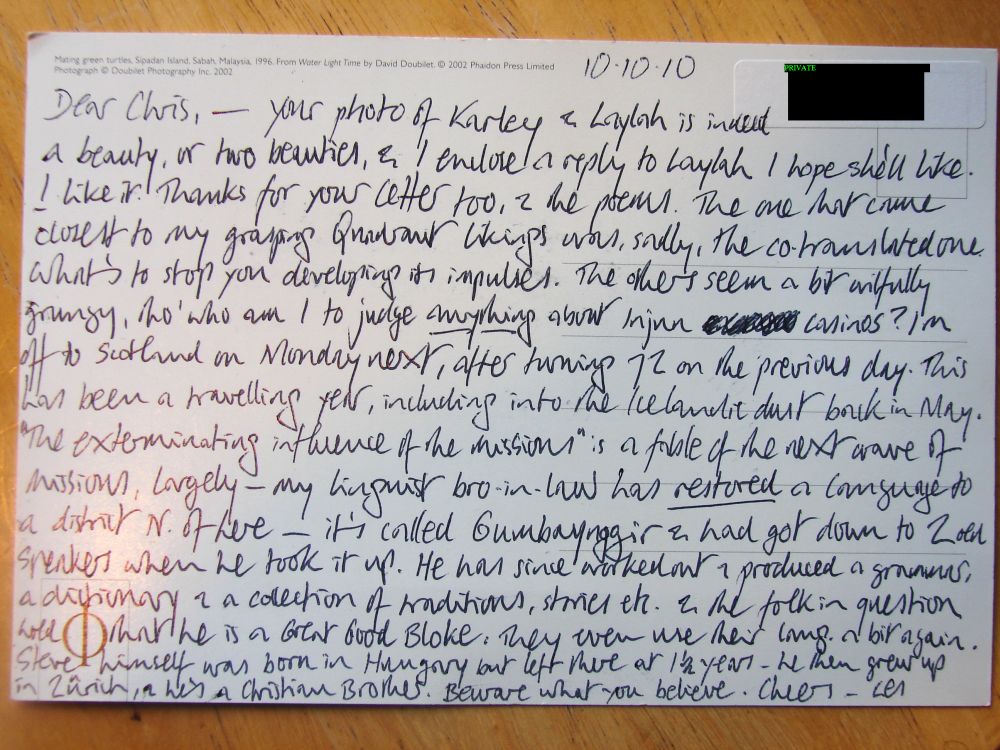
One just received -- dated, nicely, "10-10-10" -- taught me some things. It responds to a package from me that, typically, included a photograph of my wife and child. When Les first visited us in New York, my wife Karley was pregnant with our daughter Leyla; and he is the thoughtful sort who always has remembered that, so I keep him updated on them.
Your photo of Karley & Laylah [his spelling] is indeed a beauty, or two beauties, & I enclose a reply to Laylah. I hope she'll like. I like it.
His reply comes in the form of a photo of a blue bird sitting in Les' wide palm


No legs are visible. Though they could be tucked under its tufts of feathers, I imagine the bird to be legless or in some other way disabled, a natural reclamation project for the poet, an impression encouraged by a note in Les' inscription on the back.


Hi Leyla [getting the spelling right]! I'm happy to see you & your mother looking so well ------- and the blue bird is happy to be looking at all! Love from Les
I know, the tiniest acknowledgement from Justin Bieber would mean much more to Leyla herself, but I am  very proud to have encouraged correspondence between my 7-year-old and a poet whose work will out live us all.

Les also responds to some poems and co-translations of the Turkish poet Orhan Veli I had done with my friend Defne Halman. Les edits the literary section of a conservative Australian magazine named Quadrant and surprised me years ago by printing some work I had sent him; so now, though the friendship is primary to me, there is also a slight strain of literary hopeful in me whenever I send him a package in Australia.
Thanks for your letter too, & the poems. The one that came closest to my grasping Quadrant linkups was, sadly, the co-translated one. What's to stop you developing its impules. The others seem a but wilfully grungy, tho' who am I to judge anything about Injun casinos?
That means I must have sent him this poem:
THE WOUNDED KNEE KIDS BOXING CLUB
Kids are making dream
catchers for tourist pennies
The Wounded Knee Kids
Boxing Club needs money
for gloves    for gas to bruise
and travel
They have been pouring
water on their heads all day
Casino roof
the only shade    The old
massacre creek dry
like any other rut
Oh    the elite set
get seventy new houses    says the Wounded
Knee Kids Boxing Club coach    Casino
money never goes to kids
I used to have a phone    Now
I have forty-five kids    Lucky
I still got a TV
The kids
are all
on fire
This is an old poem, just this side of journalism, a bare factual report of a visit to Wounded Knee, the Sioux massacre site. The next brief bit of Les' letter is the only part of this one that is properly personal.
I'm off to Scotland on Monday next, after turning 72 on the previous day. This has been a traveling year, including into the Icelandic dust back in May.
This relates to the Eyjafjallajökull volcano eruption that made worldwide news in 2010. Les moves from this reflection to another poem I had sent, and another unpronounceable name.
"The exterminating influence of the missions" is a fable of the next wave of missions, largely -- my linguist bro-in-law has restored a language to a district N. of here -- it's called Gumbaynggir & had got down to 2 old speakers when he took it up. He has since worked out & produced a grammar, a dictionary & a collection of traditions, stories, etc. & the folk in question hold that he is a Great Good Bloke. They even use their lang. a bit again. Steve himself was born in Hungary but left there at 1 1/2 years -- he then grew up in Zurich, and he's a Christian Brother. Beware what you believe. Cheers -- Les
Wow! That's a lot to unpack at the end of a note scrawled on the back of a postcard that depicts mating sea turtles.
First, let me share my poem he is responding to.

VOCABULARY LESSON

FOR THE LAST PERSON
OF THE TRIBE TO SPEAK
THE LANGUAGE
OF OUR PEOPLE


For arrow poison, gall was boiled

down. She soaked his nuts in cum
Sundays, lengthy Elizabethan prose
Sundays, in Kansas City, Kansas.
The hair was at times plastered with clay
for 24 hours, to impart gloss
and keep it from split
ting. The exterminating
influence of the missions
was discouraging, sure,
but courage, for survivors,
was really just a curse.
A is for Absence,
B is for Bayonet in the Back of
C, or Crazy Horse,
D is for Don’t You Dare Speak Your Mother Tongue,
E is for Entrails Emptying Out of Our Soul.

Now that Les Murray mentions it, this is "willfully grungy," what with the nuts soaked in cum and splitting the word "splitting" between two lines. I suppose he and I may disagree about the value of being "wilfully grungy" -- it serves as an apt summary of punk rock, an aesthetic I respect -- but it's good to know where you are coming from, and Les has shown me once again.

If I may quibble with the great poet, however, this poem is not about the next wave of missionaries but rather the first missionary wave in American Indian country, where the languages were willfully annihlated, along with as many of the people as the bad guys could throw a measle blanket on. I'll enjoy discussing this in Bunyah one day with Les Murray and his bro-in-law Steve the linguist Christian Brother.


Saturday, October 16, 2010

Three Angela Khan poems for Andrea Van Cleef to sing


I have a new friend, Angela Khan, who uses chat software. I am getting used to it. We banter about projects, poetry, and philosophy on these little pop-up boxes in the morning.

The other morning, she tells me also is chatting with Andrea Van Cleef.


This is my Northern Italian rocker buddy. I know social media makes it infinitely easier for anybody to be a catalyst, but as an O.C. (Original Catalyst), I still pride myself in connecting people up.

Khan is getting mobbed up in our project Poetry Scores, so I told her Andrea is the one musician who has scored me. I populated our chat box with a link to a demo of his song to my poem "I used to be precocious".

Then, I really got to thinking. Khan had just sent me some of her own poems. My first thought was that they would be fun to sing. So I told her I would post her poems and send the link to Andrea and see if he could come up with some songs.

The Quiet Room
By Angela Khan


Murderous imaginings are suppressed in the light blue room
Confined shadows compress against the break room’s skin
slaloming through the silence, a slavish floor to broom

echoes race but time always wins
down the hallway donning a boyish grin
and stooping yet strong, the figure’s work never ends
sweeping accusations - life's blind custodian
begins to whistle woes unforgivable

in the coded key of Zen

Kind of reads like a Natalie Merchant lyric to me.

Bastille day is today
By Angela Khan

Bastille day is today
ever heard of this celebration?
You think you’re the King; I'm French; pay attention---

Behead thee King and drama Queen
I'm casting thy booty to the sea
your riches nil value and useless to me
Let us chisel this date into your dull memory
Rest your neck upon it's cold nape

Run through your lines just one more time before never
it is too late
to tip me
Learn from the stillness of the stone
and its silence
Even your darkest knights are lame
like your face we've saved from the
wages of slaves

Tails down You lose!
Heads off!
just proves
today is the day Bastille!

I'm melting the molds of victory waxes
paid for with your Icarus' taxes
Bastille!

Hone the blade
then bury the axes
Mark my face with Pheonix' ashes!

I'm writing you off with the ink from your spill
take a hard look what's come from this quill
thank you
thank you
thank you

Today we celebrate my Bastille!
Come to think of it, that also has a touch of early Natalie.

red on red
By Angela Khan

Moving away from or coming towards depending on the wave length in colors and the speed at which I hover contemplating red I pull the covers over my head and the blackbirds aren't birds they were rats in a dream I once had when I was running over past events in my memory bare feet protected by angels didn't cut over bottles broken in an alley careless of the crime motion blurred visions of one time when I hadn't a dime or second to spend running through alleyways in my head it didn't matter much because my feet were tough and I owned no watch on the wrist to say late to the party to tell a story so great about love and loss of no blood and the police breaking rules to give me a lift and wishing me well in this here district why didn't I tell them? that My favorite Italian shoes were in that bag too. And what of the artwork that took a semester to do? Nevermind my faith in humankind and nevermind all of those things once called mine. Nevermind. Nevermind. Nevermind. Back to

contemplating red on red

And that one even has "Italian shoes"! Come on, Van Cleef, you can do something with that.

Monday, October 4, 2010

Tim McAvin, amateur soldier actor, is holding hostage my shoes


As the King/McAvin shoe hostage crisis enters its second week, I have taken to wearing my dress shoes to work. This situation is getting serious.

It all started on location in Cuba, Missouri, one week ago yesterday. It was our first day of shooting the new Poetry Scores movie, Go South for Animal Index. After a long day down at the creek, shooting our Coyote character (Kyla Webb) trading his moonshine to PFC Sack (Thom Fletcher) for hamburgers and to Badger (Roland Franks) for fresh fish, we moved up to the McPheeters' house.

I had picked out an upstairs porch to shoot the country dance scene. Our movie is based on a poem of the same name by Stefene Russell that is about the atomic bomb. My storyline centers on Lost Almost, as the soldiers called Los Alamos, where the first atomic bomb was invented and tested. The scientists lived a fairly active, if insular, social life when they weren't splitting the atom and weaponizing the resulting energy, and I wanted to reflect this fact with a mad scientist country dance.

Lost Almost was a secret military installation, and since we make silent movies, the best way to make this clear to the viewer is to have armed soldiers present at almost all times. So I asked for our soldier actors (Fletcher, Thomas Crone, Tim McAvin, John Parker) to make this shoot so they could surround the scientists and their wives while they danced.

We were just about to start shooting when I reviewed our soldiers' costumes. Everybody was looking pretty good. Then I looked down at McAvin's shoes. They were brown sneakers. When I asked the soldier actors to costume themselves, I specified black boots for their footwear. Brown sneakers absolutely would not do

Photo by V "Elly" Smith

My fussing about this costume blunder called attention to Tim's shoes. Since I was standing right in front of him, this also called attention to my shoes. Barbara Manzara, who is playing a scientist wife but also had been helpful all day with costumes, pointed out that my shoes - my beloved, lovely shoes - were black. At a glance, which is all the viewer would ever give the shoes of any of our soldiers, they would pass for boots. So Tim and I switched shoes.

Photo by V "Elly" Smith
It turns out we have almost exactly the same sized foot. The show went on, and I am quite certain no one who ever sees our movie will guess that one of the soldiers is wearing beloved, lovely black shoes that are not boots.

Directing a movie all day is a heady, exhausting experience. It takes you out of yourself. I stopped think about my feet or my shoes. By the time I started thinking about my feet or my shoes again, the shoot was over and Tim McAvin was gone from the location, he was absent from Cuba, he was on his way back to St. Louis wearing my beloved, lovely black shoes. I was stuck with the brown sneakers.

I am certain that Tim was able to walk off with, and in, my shoes because they fit so well. Tim and I carry our weight in a remarkably similar fashion. I have a long history of neck and back injuries and am unusually sensitive to how I bear my weight. I wouldn't last an hour in the shoes of a man who carried his weight in a way that felt wrong to me. I am sure my shoes felt right on Tim, because Tim's shoes felt pretty right on me.

They felt pretty right on me for a day or two, that is. Then, they started to feel wrong. The small differences in how we bear our weight and have imprinted our shoes began to become obvious to me. Tim's shoes began to bother me. My back began to ache. I don't really have any other comfortable, casual shoes. I was stuck with Tim's brown sneakers.

So I started to take my shoes - that is, Tim's shoes - off at work. The people who work with me began to object to this, and who could blame them. And so I, a week now into the McAvin/King shoe hostage crisis, I have started to wear my dress shoes to work.

I like my dress shoes. They are perfectly comfortable shoes. But they are not my beloved, lovely black shoes. Those shoes are in the custody of - in effect, being held hostage by - one Tim McAvin. And I want them back!

I have tried to get them back one time. One evening last week, This is where it starts to get suspicious. Oh, sure, Tim said. You can come and get your shoes. No problem. But you'll have to come and get them, he said. He didn't have a car that night. I took down his address. I drove toward his home in South County. As I drew near, to nail down directions to his door, I called Tim.

And, suddenly, there was no Tim on the phone. Suddenly, his phone was doing that thing when the person who has the cell phone plan tells the cell phone company his phone isn't going to be a working phone for awhile. Tim dodged me. Tim is dodging me. Tim is holding my shoes hostage! Tim, bring me back my beloved, lovely shoes!